Building toward launch — early access now open
No more wondering if you have the right laser settings.
LaserDx is a clinical reference for aesthetic providers — verified parameters by device, indication, and Fitzpatrick skin type, sourced against the literature and key opinion leaders.
Dermatologists·Plastic surgeons·Aesthetic nurses & PAs·Medical trainees
What it does
Look up a device or an indication. Get the parameters that are actually right for the patient.
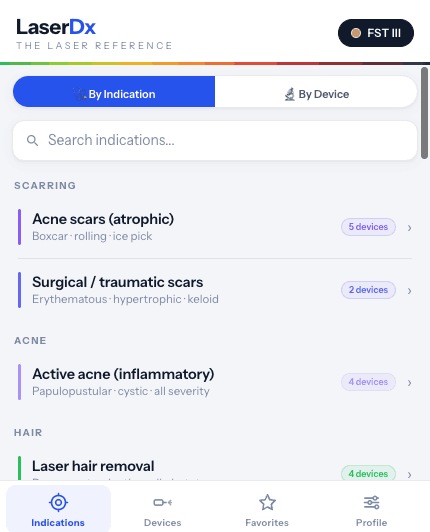
Search by indication or device
Start from the patient's condition or the platform in the room. Every entry cross-links to the other.
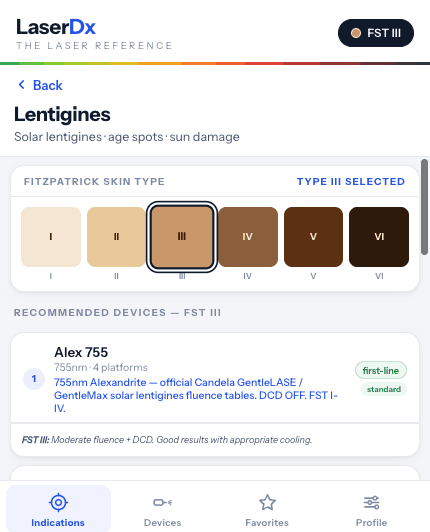
Fitzpatrick-aware, every time
Set the skin type once. Recommendations, risk flags, and parameter ranges adjust automatically.
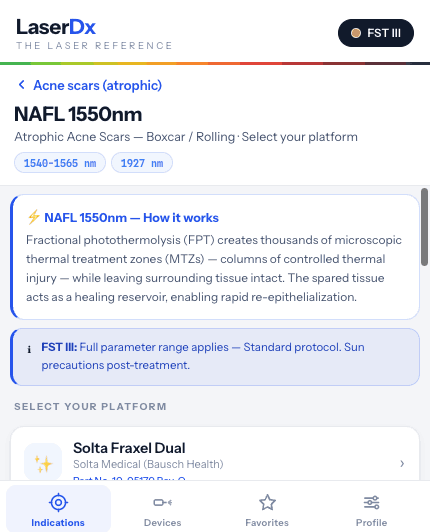
The mechanism, not just the number
Every protocol comes with the "why" — the biology behind the setting, so you know why, not just what.
Sourcing standard
Every parameter is graded, cited, and dated.
Protocols are ranked by evidence level and tagged first-line or standard, so it's clear at a glance what's well-established versus what's emerging. Manufacturer defaults, published literature, and clinical consensus are kept visibly separate — never blended into one unsourced number. Settings are revisited as new literature and practice protocols emerge, so the reference stays current.
first-line
standard
caution
avoid
⚡ Fractional photothermolysis — how it works
Fractional photothermolysis creates thousands of microscopic thermal treatment zones while leaving surrounding tissue intact. The spared tissue acts as a healing reservoir, enabling rapid re-epithelialization.
Example excerpt as it appears in the reference — sample content, sourced and cited in the full entry.
Be first in the room when it launches.
No cost to join. We'll reach out with early access before public launch.